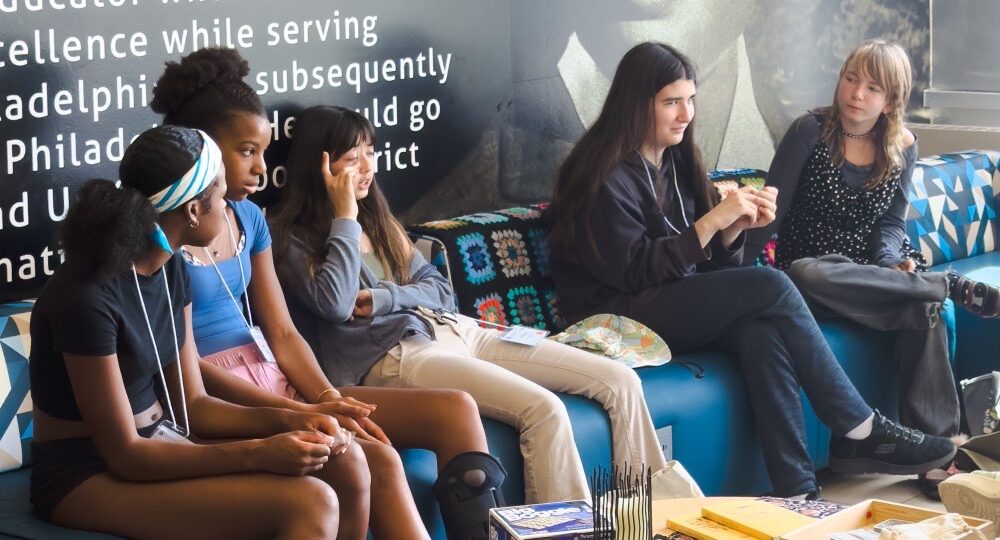
Meetings connected to Friends schools are asked to share this article with teachers, parents, board members, and others in their school communities. Friends who share it can consider how their meeting might welcome families whose connection to the Religious Society of Friends comes through the school their child attends. Sharing the article can be one way to help those families learn that their connection to Friends can extend beyond the school community.
Philadelphia Yearly Meeting
Remembering Gene Elston Hillman

On May 2, 2026, Gene Elston Hillman, 82, died in the West Chester Hospital of the University of Pennsylvania of "natural causes".
Gene was born October 26, 1943 to Barbara Kelley Hillman and Elston Hillman in another University of Pennsylvania hospital, this one in Philadelphia — a hospital that literally saved his life in the 1980’s, almost 50 years later. Gene’s early years were spent in what was then the “farm country” of Downingtown, where he liked to say his closest playmates were “cows and horses” as well as the three large Collies his parents owned as pets.
Appeals Court Backs Philadelphia Yearly Meeting in Lawsuit Against Trump Administration | Press Release

In the following press release it shares on Philadelphia Yearly Meeting’s lawsuit against the Trump administration to protect religious freedom and the right to worship without fear in spiritual communities.
Deborah Cooper | An Intergenerational Talk | Quaker Aging Resources Video

Deborah Cooper shared with former Quaker Aging Resources intern, Joey Szpilczak, sharing a reflection on a Quaker-led humanitarian effort during the Bosnian War. [Read more…] about Deborah Cooper | An Intergenerational Talk | Quaker Aging Resources Video
Friends for Lesbian, Gay, Bisexual, Transgender and Queer Concerns Epistle

To All Friends Everywhere.
We greet you warmly and open this epistle with a part of the vision statement of Friends for Lesbian, Gay, Bisexual, Transgender and Queer Concerns (FLGBTQC):
Ours is a Quaker faith community committed to justice, liberation, and the full affirmation of diverse sexual orientations and gender identities. We honor the divine Light in all humans and nurture a deep well of faith that sustains courageous witness in the world. We gather to listen deeply to the Spirit, to one another, and to the spoken and unspoken messages that rise among us.
Through direct experience of the Light, we seek spiritual refreshment, fellowship, and the bonds of love that we discover in our shared differences. We affirm loving, Spirit-led sexuality and gender expression as powerful, Divinely bestowed gifts. Guided by this sense of sacred queerness, we reclaim faith as a source of power and resistance, embodying a living testimony of inclusion, equality, and deep, nourishing love.
We came together at the University of Vermont during the Friends General Conference Gathering July 7-12, 2026. In 2024 at Gathering at Haverford College in Pennsylvania, we sat in discernment over the future of the organization. We listened deeply to one another, worshiped together, felt the profound love that has always been the hallmark of FLGBTQC. Over the last year a “Steering Committee” has been working together to examine next steps. They engaged the community in a lengthy survey that asked hard questions including the possibility that FLGBTQC should be laid down. It’s noteworthy that seven times as many people responded to the survey than had in 2022 and there was an overwhelming desire to revitalize the organization. From the Steering Committee four sub-committees were formed: the Reconnecting Subcommittee, the Rebooting Subcommittee, the Revisioning Subcommittee and the ReGathering Subcommittee. Friends did great, creative work including three online threshing sessions.
We are delighted to report that FLGBTQC is alive and revitalized, stronger than ever in spirit. Themes of gratitude were abundant in our Meetings for Worship and our Meetings for Worship with Attention to Business were spirit led. We have clerks, a working Nominating Committee, and Friends joining all the committees: Ministry and Counsel, Online Presence and Tech, Finance and Fundraising. It was very moving to be together in our hybrid format. A Friend wrote: “Being in a room of queer folks of all generations is incredibly meaningful.”
Humor was evident in our work together. Our co-clerk kept referring to doing an agenda review as a gender review! And to the Rebooting Subcommittee as the Rebooting Commootee. We accomplished a lot in our Business Meetings this week because we were so present with each other and Spirit and trusted in the work of our committee. The Rebooting Subcommittee determined that groups.io might better serve our online needs and over 100 Friends have tested this online platform. Hoots and hollers of gratitude were heard as we approved going forward with groups.io as the platform for our communication, a place where we may know each other deeply and honestly. We further approved the 5-year road map proposed for first stabilizing our structure, then expanding our capacities online and with regional gatherings, and finally bringing our online and in-person community together. There are already two regional gatherings in the works for 2027 and the possibility of a national mid-year hybrid gathering in 2028 Infused in all our work is attention to accessibility for all. We seek the participation of people of all generations to serve FLGBTQC in leadership roles.
The Religious Society of Friends (Quakers) has had a long witness supporting LGBTQ+ rights, spiritual gifts and equality. Now, in a time of mounting backlash and rising discrimination against transgender people, four Yearly Meetings within Quakerism have named transgender Friends to prominent roles. FLGBTQC sends these Friends our care and support in their new roles and blessings for their service. We also send our care and support to transgender people in all places. We continue, as always, to pray and work for a world where each person’s dignity is honored and each person’s spiritual gifts and talents are nurtured by their communities unconditionally.
On behalf of Friends for Lesbian Gay, Bisexual, Transgender and Queer Concerns,
John Skinner and Karen Lightner, co-clerks
clerks@flgbtqc.org
http://flgbtqc.org
A Successful Friends Experiment
As Friends left the Zoom waiting room and joined “The Friends Experiment,” one could sense just a hint of trepidation in the virtual air.
Upper Susquehanna Quarterly Meeting Invites all Friends for its Annual Fall Family Gathering | Press Release
Upper Susquehanna Quarterly Meeting invites all Friends, members and attenders, along with families, seekers, nature lovers, and anyone interested in learning more about community, to gather for its annual Fall Family Gathering at Crystal Lake Camp in Hughesville, Pennsylvania, from Friday, September 25, to Sunday, September 27, 2026. [Read more…] about Upper Susquehanna Quarterly Meeting Invites all Friends for its Annual Fall Family Gathering | Press Release
New Child and Youth Safety Policy for Philadelphia Yearly Meeting

At the recent joint council meeting Philadelphia Yearly Meeting staff shared the revised Child and Youth Safety Policy noting the guidance of leadership, reviews by others, and editing by lawyers. The policy is materially the same as before. [Read more…] about New Child and Youth Safety Policy for Philadelphia Yearly Meeting
The Original 1688 Germantown Quaker Petition Against Slavery Is On View at Arch Street Meeting House | Press Release

The Original 1688 Germantown Quaker Petition Against Slavery is on view at Arch Street Meeting House The original 1688 Germantown Quaker Petition Against Slavery will be on view from June 29 to August 9, 2026. The 1688 Germantown Quaker Petition Against Slavery was last publicly exhibited in the summer of 2007 at the National Constitution Center. This Summer, it will return to Arch Street Meeting House for the first time since 2006, where it was discovered after its nearly two-century disappearance from the historical record. [Read more…] about The Original 1688 Germantown Quaker Petition Against Slavery Is On View at Arch Street Meeting House | Press Release
Juneteenth and the Continued Journey Toward Equality | Addressing Racism Collaborative
Authorship attributed to Joan Broadfield, member of Addressing Racism Collaborative.
All around our Quaker meetings there are institutions in the communities celebrating the African American past and present, and June is a month to learn and visit. Consider the meaning of Juneteenth, a day that African Americans celebrate to recognize the end of the civil war and the beginning path to equality. Quaker history has not always reflected a testimony of true equality. By putting Juneteenth in all our lives as an important time, we expand our sense of shared community. Consider the larger history that those of us who are of European heritage may not viscerally feel. Growing up at an HBCU in my white family, being part of that community, I learned more than I realized, and it feels part of me. We need that for our Quaker community. [Read more…] about Juneteenth and the Continued Journey Toward Equality | Addressing Racism Collaborative
