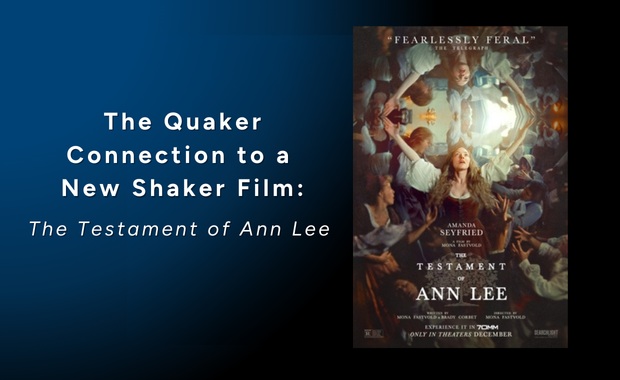
The Religious Society of Friends has appeared across popular entertainment, in shows like Six Feet Under, Outlander, and Long Bright River, and on stages as well. Ann Lee (1736–1784) was raised a Quaker in England and later left the society. This month, her life is retold in a new movie-musical, The Testament of Ann Lee, which follows her journey and her escape from religious persecution in eighteenth-century England. The film stars Pennsylvanian actor Amanda Seyfried.
The Testament of Ann Lee is not about Quakerism. It follows a Christian religious movement people often mix up with Friends, though they are not the same community. The religious sects formal name was the United Society of Believers in Christ’s Second Appearing and which became known to outsiders as the Shakers, or “Shaking Quakers” (a nickname that adds to the mix-up).
Ann Lee, as well as a few others, came out of Quakerism. Ann’s early time among Friends informed parts of the community she later led, which is why the two groups were and are still so often mistaken for one another.
Shakers came out of early Quaker life. They shared commitments around equality and the Spirit, then carried those beliefs through dance, song, and close communal living rather than silence and waiting worship. Alan Crosman, a lifelong Friend who has served as a docent at Arch Street Meeting House for about fifteen years, shared some context on where the Shakers came from and how they connect to Quaker history without becoming Quaker history itself.
Alan shared, “Mother Ann, Ann Lee, was originally a Quaker. There were a couple of women in England who were part of the earlier movement, and they had Quaker backgrounds too.”
He continued, “A lot of ideas carried over, like pacifism and equality between men and women. Those can be traced back to early Quaker thought. But the expression of those ideas went in a very different direction.”
“The foundation is similar,” Alan said. “Both believe people are moved by the Spirit to contribute to worship. Quakers express that through silence and spoken ministry. Shakers expressed it through movement and song.”
Many Friends, along with people from other faith traditions, know Shakers through their music, including songs like Simple Gifts and I Will Bow and Be Simple.
He added, “It was charismatic. It’s similar to Quakers in that sense, but much more vocal. People took part through dancing, singing, and movement rather than sitting in quiet contemplation.”
Alan also explained, “Things like enthusiasm in worship sometimes get misunderstood or mischaracterized, but that wasn’t what they were doing.”
Alan continued on the Shakers. “They were a faith community, a small one. They originated in England, but that didn’t last very long there. They came to New York just before the American Revolution.”
He continued, “They thrived during the evangelical movements and Great Awakenings, but their decision to live as celibates shaped their future. They believed Christ was going to return at any time, so procreation wasn’t necessary.”
Today, the Shakers still exists in North America but the congregation is small. Alan shared, “In the nineteenth century, they did provide foster care for orphans, and some of their growth came from children who were raised in the community and chose to stay. But they were mostly dependent on people joining.” He noted that there is still a very small Shaker community in Maine, often referenced as the last remaining members of the tradition.
Alan shared that a key difference between the two communities was foundational on how each developed. “Shakers were very tied to Christianity. The formal name is the United Society of Believers in Christ’s Second Appearing. That millennial belief really drove them. Quakers have some of the same theology.”
He referred to George Fox’s Journal. “The classic Quaker line from Fox’s journal is that Jesus is come to teach his people himself. For Quakers, God is immediately available, and that is the manifestation of that second coming. Whereas for Shakers, it’s something that will come.”
The Testament of Ann Lee will be in theaters beginning December 25, 2025. It is not the only 2025 film to reference the Shakers; Oh, Hi! a romantic comedy, includes a scene focused on Shaker furniture. Friends are invited to learn more about Quaker history by visiting Arch Street Meeting House, open Thursday through Sunday from 10:00 a.m. to 4:00 p.m. The site will be closed for the winter season beginning January 1, 2026, and will reopen in spring 2026.
Photo by Courtesy of Searchlight Pictures - © Searchlight Pictures
