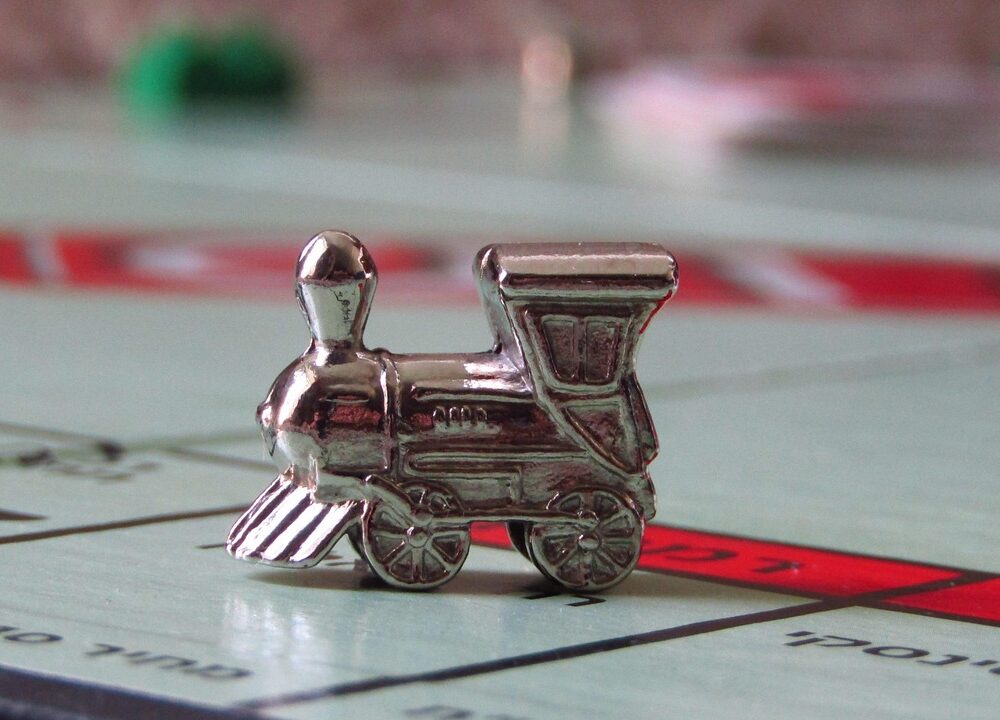
I spoke with Diana Brose, member of Woodbury Monthly Meeting who shared a fun, family and Quaker community story about the game of Monopoly and Quakers involvement in its development. When Diana’s grandparents both taught at a Quaker school in Atlantic City, NJ they lived a low-income lifestyle. Their daughter was born in 1925 who was Diana’s mother. Since housing was so expensive, they spent their summers traveling in an old jalopy cross country visiting friends. Diana’s grandfather was a friend of Paul Cope, a Quaker who was co-owner of Hotel Morton, a Quaker owned family-oriented hotel.
This friendship was mentioned in a book Monopolists, by Mary Pilon. The promotion for the publication stated “Ralph Anspach, a professor fighting to sell his Anti-Monopoly board game decades later, unearthed the real story, which traces back to Abraham Lincoln, the Quakers, and a forgotten feminist named Lizzie Magie who invented her nearly identical Landlord’s Game more than thirty years before Parker Brothers sold their version of Monopoly.” The professor’s legal efforts included Diana’s mother giving a deposition on the case.
More background was shared on Thee Quaker Podcast in an episode titled “The Making of Monopoly: How Quakers Shaped the World’s Most Popular Board Game.” In the interview, the daughter of Ruth Hosins, a Friend and a friend of Diana’s mother, said her mother drew the first Atlantic City Monopoly board with help from other Friends. She said, “The original board was painted by my mother and there were two or three other Quakers at the Friends school who were involved in this process.” She also said that Ruth and a real estate agent friend pulled tax records at City Hall to determine land values for Atlantic City properties, railroads, and utilities, then Ruth painted the board on an oilcloth tablecloth, including spaces like Boardwalk, Park Place, and Marven Gardens.
The Encyclopedia of Greater Philadelphia also shared the story, “The proper history of Monopoly began in the early 1900s when a stenographer living near Washington, D.C., Elizabeth “Lizzie” Magie (1866-1948), created a game to demonstrate the destructive and anti-social nature of monopolies as outlined by the famous nineteenth-century political economist Henry George (1839-97). Lizzie called her invention The Landlord’s Game.
The object of The Landlord’s Game was to obtain money and wealth by purchasing properties, charging rent, and creating monopolies. Lizzie’s square board included twenty-two property deeds, four railroads, two public utilities, and four corner spaces. She labeled one of her corner spaces “Mother Earth.” Each time players passed “Mother Earth” they collected $100 in wages. Lizzie patented her game in 1904.
As recently as February 24 , 2025 another article was published by Woodbrook in UK about this story. Again, there’s a reference to the Atlantic City Quakers who made changes to the game like the one used today. This hidden story of the artist friend of Ruth Hoskins, Diana Brose’s mother is one to enjoy!
Friends can learn additional information in Monopoly, by Ruth Hoskins, Friends can also follow the legal trail here.
Sharing Diana’s story was influenced by a pamphlet on Celebrating Lives and Life Stories found on Quaker Aging Resources. This article was prepared by Sheila Sorkin, Philadelphia Yearly Meeting, Aging Support Coordinator in collaboration with Philadelphia Yearly Meeting Communications, to provide support, resources and engage the aging community of the Philadelphia Yearly Meeting as part of the “To Brighten Your Day” series. Quaker Aging Resources is supported by Friends Foundation for the Aging.
