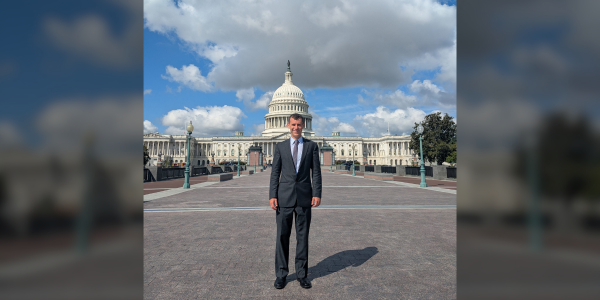
This article is attributed to Ethan K. Birchard is the Executive Director of Friends Fiduciary Corporation.
With geopolitical instability on the rise, in recent years global conflicts have continued to grow. A year ago, the Washington Post reported that 30 percent more people were killed in violent conflict in 2024 than in 2023, with conflict at its highest level since World War II. In 2026, despite the ceasefire in Gaza and the ongoing stalemate in Ukraine, stability seems, if anything, more elusive than ever. The US administration’s actions around South America and rhetoric over Greenland have only added to that tension.
Such a tragic level of violent conflict matters urgently to us as Friends. It should also matter to investors. In a 2023 Ernst & Young survey of 1,200 private sector CEOs, 97% said they had altered investment plans due to geopolitical volatility. Nearly a third had halted planned investments. In a 2024 survey of several of the world’s largest investment firms (representing over $6T in capital), 84% of respondents identified geopolitical confrontation as a “top three” concern.
Friends Fiduciary does not invest in companies producing lethal weapons or weapons components. But Friends Fiduciary does actively engage many companies to prevent or mitigate their indirect support of violence, typically using the investor framework of conflict affected and high-risk areas (CAHRA). Today many of our active engagements address CAHRA, including:
- Ukraine and Russia, where Russia’s invasion of Ukraine in 2022 has resulted in hundreds of thousands of deaths over nearly four years—including tens of thousands of civilian deaths—while reconfiguring Western economies away from Russia. Friends Fiduciary has engaged companies to prevent conflict-related human trafficking and the illegal diversion of semiconductors to Russia for weaponized purposes.
- Israel and Palestine, where at least 70,000 people, many of them also civilians, have been killed since October 2023, and where discrimination and occupation exacerbate human rights challenges, injustice, and corporate risk. Friends Fiduciary is engaging large companies whose contracts with the Israeli Ministry of Defense and/or Israel Defense Forces may enable powerful technologies to be weaponized for targeting and surveillance purposes, as well as companies whose products may support discrimination in Israel and the Occupied Palestinian Territory.
- China, particularly in the Xinjiang Uygur Autonomous Region (XUAR), where the mass detention, surveillance and oppression of millions of ethnic Uyghurs have created a human rights crisis with acute implications for the many companies doing business with the country. Friends Fiduciary is engaging multiple technology companies that work with the Chinese government or government-linked businesses in a way that appears supportive of repression in the XUAR.
- The United States, where an immigration enforcement crisis has recently included several high-profile killings, along with dozens of deaths in detention, violent encounters, wrongful deportations and family separations. Friends Fiduciary is engaging multiple companies to understand whether their products or policies risk indirectly contributing to these harms, or to others such as racial profiling, insufficient due process or violations of basic privacy rights.
When we’re able to publicly share the details of these engagements, we do. In most cases, however, maintaining trust in dialogue and negotiating in good faith as investor owners means respecting corporate expectations around confidentiality and discretion.
Many other CAHRA can be difficult for investors to directly address, or even prohibitive for doing business. Some of these include Sudan, Myanmar, Syria, the Democratic Republic of Congo, Mexico, the Sahel, Haiti, Pakistan, Afghanistan, Iran, Colombia, and Venezuela—all of which face major human rights crises through violent conflict and/or repression. But when we identify opportunities to push portfolio corporations to address risk and support positive change in these and other CAHRA, we pursue those opportunities as well.
In our current engagements, perhaps foremost among several themes is the potential or actual weaponization of powerful new technology. Cloud and data storage, biometric data and tracking, and artificial intelligence (AI) are just a few emergent technologies now being deployed in state surveillance and military conflict. In my most recent update, I shared the details of Friends Fiduciary’s Peace Testimony Convening, which included discernment around these technologies and a determination to factor in positive long-term engagement as a key consideration in some of our investment decisions. Several of our current engagements around weaponized technology are a direct result of that work.
Today, these challenges are especially prominent for companies and investors thanks to market concentration in AI-focused large technology companies. This concentration raises the urgency, and the stakes, on our CAHRA-related investor advocacy work. If we can help the largest companies in the world focus on these critical business risks and draw a line on the use of technology products in CAHRA, we have a great opportunity to ensure the weaponization of AI and other emerging technologies does not become the new law of the land.
About the author: Ethan K. Birchard is the Executive Director of Friends Fiduciary Corporation. Ethan’s 25-year career includes growing a robust sustainability practice, modernizing marketing and operations for a 40-year-old investment firm, driving top- and bottom-line growth for a global professional association through strategic product development and digital marketing, and leading collaborative, cross-functional teams. Non-profit board work includes The Energy Co-op of Pennsylvania (President) and Friends of Wissahickon. BA, Amherst College; MFA, The New School in New York.
